
Imagine someone opens ChatGPT and asks:
“What’s a good eyebrow threading salon near me?”
Or:
“Can you recommend a plumber in Escondido who repairs water heaters?”
Or:
“Find a well-reviewed auto repair shop close to me.”
Where do those business names come from? Does a company have to register with ChatGPT? Does ChatGPT look at websites? Does location matter? What about reviews and other places where your business appears online? And perhaps most importantly: why might one local business appear while another doesn’t?
The answer is more nuanced than a traditional search-engine ranking, and it is closely related to what we call AI visibility. Let’s make it simple.
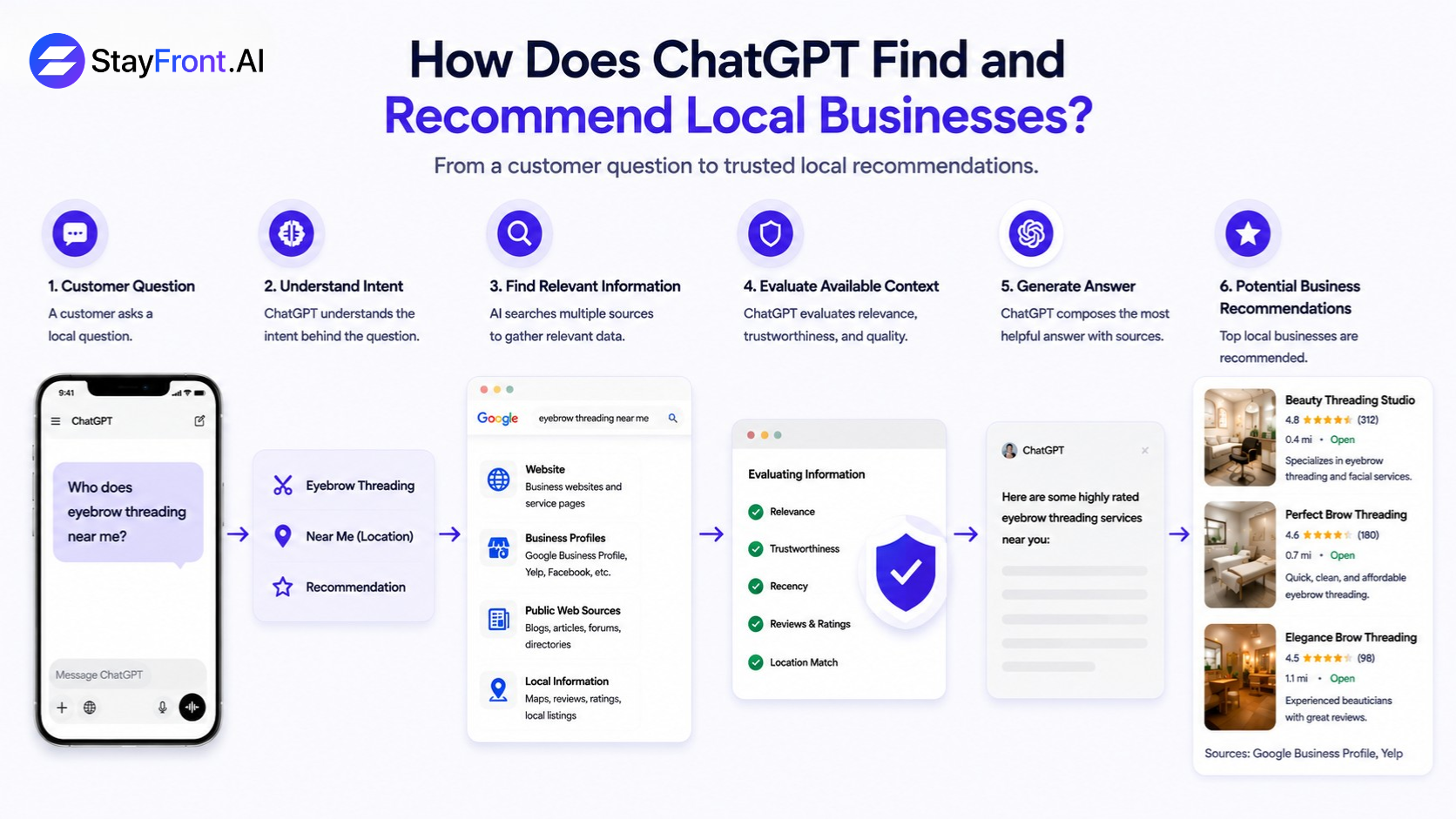
ChatGPT is not a traditional business directory
There isn’t one master directory where every local business submits an application to become “listed in ChatGPT.” ChatGPT is an AI assistant. When a question would benefit from current information, ChatGPT can search the web and provide answers containing links or citations to relevant sources. For local searches, location can also help make the answer more relevant.
That means the journey from a customer question to a potential business recommendation can be more dynamic than a conventional list of search results. The exact sources, ranking factors and response can vary.
A simple way to think about the process
The infographic above illustrates the concept. It should not be interpreted as an exact internal ChatGPT algorithm.
1. The customer asks a question
A customer might ask:
“Where can I get my eyebrows threaded near me?”
That request contains more information than a simple keyword. It may communicate:
- Service: eyebrow threading
- Location: near the customer
- Intent: find a business
Another query might add:
- Timing: today
- Reputation: well reviewed
- Price: affordable
- Specific need: water heater repair, brow lamination, transmission repair, and so on
Conversational questions can contain much more context than traditional two- or three-word searches.
2. ChatGPT interprets the customer’s intent
Consider the difference between:
eyebrow threading
and:
“Where can I get eyebrow threading near me today?”
The second request combines several ideas:
- service
- local intent
- timing
- recommendation intent
ChatGPT search can rewrite a user’s question into one or more targeted web searches when doing so would help answer the request. For example, a broad conversational question may become a more targeted search that includes the relevant service or geographic area. That is one reason clear service and location information on your business website matters.
3. Current web information may be used
Local business information changes constantly. Businesses:
- open
- close
- relocate
- change phone numbers
- update hours
- add services
- change websites
- receive new reviews
- receive new media coverage
For questions where current information matters, ChatGPT can search the web, and public websites can potentially appear in ChatGPT search. For publishers and businesses that want their public content to be discoverable, OpenAI advises allowing its search crawler, OAI-SearchBot, to access appropriate public pages. This doesn’t guarantee placement. It simply helps make eligible public content accessible for discovery.
4. Location can affect local results
Location obviously matters when someone asks:
“What’s a good coffee shop near me?”
A useful answer in San Diego should be different from one in Chicago. ChatGPT search can use approximate location derived from a user’s internet connection, and users may also choose to share device location in supported experiences for more precise nearby recommendations.
That reinforces an important lesson for local business owners: make your location easy to understand. If customers visit your business, clearly state the city and address where appropriate. If you are a service-area business, clearly explain the areas you serve. For example:
Serving Escondido, San Marcos, Vista and North San Diego County.
provides considerably more context than:
Serving Southern California.
What information should your business make easy to understand?
There is no official checklist saying “complete these ten items and ChatGPT will recommend your company,” and StayFront.AI will never suggest otherwise. However, businesses can make their public information much clearer.
Your business name
Use your legitimate business identity consistently. Customers should not have to decide whether:
- ABC Plumbing
- ABC Plumbing Services LLC
- ABC Home Solutions
are the same business unless those variations are genuinely necessary. Clear, consistent identity reduces ambiguity.
Your location or service area
Clearly communicate where you operate. For physical businesses, make the location straightforward. For service businesses, describe the cities or regions you actually serve.
Residential plumbing services throughout Escondido, San Marcos, Vista and North San Diego County.
This provides meaningful local context.
Your services
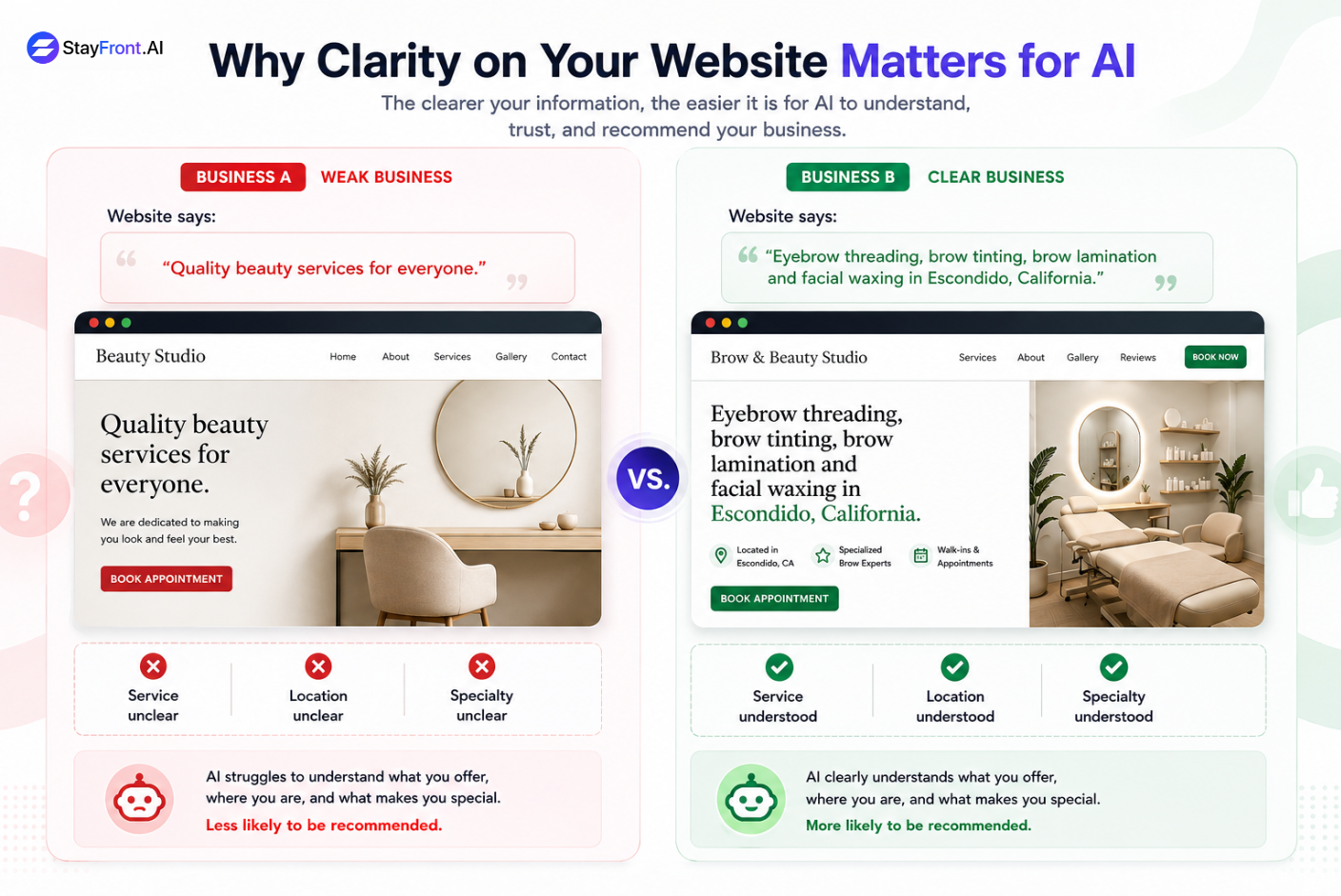
This is one of the biggest opportunities for many small-business websites. Compare these two examples.
Business A: “Quality beauty services to help you look and feel your best.”
That may sound attractive, but it doesn’t say much.
Business B: “Eyebrow threading, full-face threading, brow tinting, brow lamination and facial waxing in Escondido, California.”
The second description gives customers — and systems interpreting the webpage — far more useful context. Specificity matters. Don’t make anyone guess what your business actually does.
Your website still matters
AI discovery does not make your website obsolete. Your website remains one of the few places where you directly control the official explanation of:
- who your business is
- what you offer
- where you operate
- what makes you different
- how customers can contact you
- important service details
- policies
- frequently asked questions
- expertise
A website that barely explains a business gives customers and automated systems less useful first-party information to work with. Your goal should be simple: make the business unmistakably clear.
What about reviews?
Reviews are extremely important to customers, and they contribute to the broader online reputation surrounding a business. But avoid simplistic promises such as “get 50 reviews and ChatGPT will rank you.” There is no published universal ChatGPT local-business formula that says this. A better strategy is to:
- ask satisfied customers for genuine reviews
- respond professionally
- maintain accurate profiles
- avoid purchased or fabricated reviews
- build a credible reputation over time
Authentic reputation is valuable regardless of which discovery platform a customer ultimately uses.
What about business profiles and other websites?
Your business probably exists in many places besides your own website. Depending on the business, these may include:
- search and map listings
- review platforms
- social profiles
- industry directories
- professional associations
- booking platforms
- local news
- community websites
- chambers of commerce
- trade organisations
- other reputable third-party sources
These places contribute to your broader public presence. The objective should not be to create hundreds of directory listings. Instead, make important and credible sources accurate. Quality and consistency are more useful than mass-producing low-value listings.
Why might ChatGPT not mention my business?
There can be many reasons. One missing result does not automatically mean your business has a problem — AI answers can vary. However, repeated visibility gaps can reveal areas worth investigating.
Reason 1: Your website is too vague
Suppose you repair water heaters, but your website says “complete home solutions.” That makes the relationship between your company and water-heater repair unnecessarily difficult to understand. Be specific.
Reason 2: Important information is missing
Your website or online presence may not clearly communicate:
- location
- service area
- services
- business identity
- specialties
- hours
- website
- contact information
Missing information creates uncertainty.
Reason 3: Information conflicts across sources
Imagine your website lists one phone number and a directory lists another; one page has an old address and another lists your previous opening hours. Even if a particular inconsistency does not directly control an AI recommendation, conflicting public information creates unnecessary ambiguity for customers and discovery systems.
Reason 4: Important public pages cannot be accessed
Technical problems may make useful information difficult to discover. Examples include:
- accidental noindex
- inappropriate crawler blocking
- broken internal links
- incorrect canonical URLs
- pages hidden behind authentication
- server errors
- CDN or firewall restrictions
Businesses interested in ChatGPT search discoverability should ensure that appropriate public content isn’t inadvertently blocking OAI-SearchBot.
Reason 5: Competitors have a stronger public presence
A competitor may have:
- clearer service pages
- stronger local relevance
- more useful content
- greater public recognition
- better third-party coverage
- more accurate business information
- a more established online presence
That doesn’t mean they will always appear. It means there may be useful gaps for you to investigate.
Reason 6: The customer asked a different question
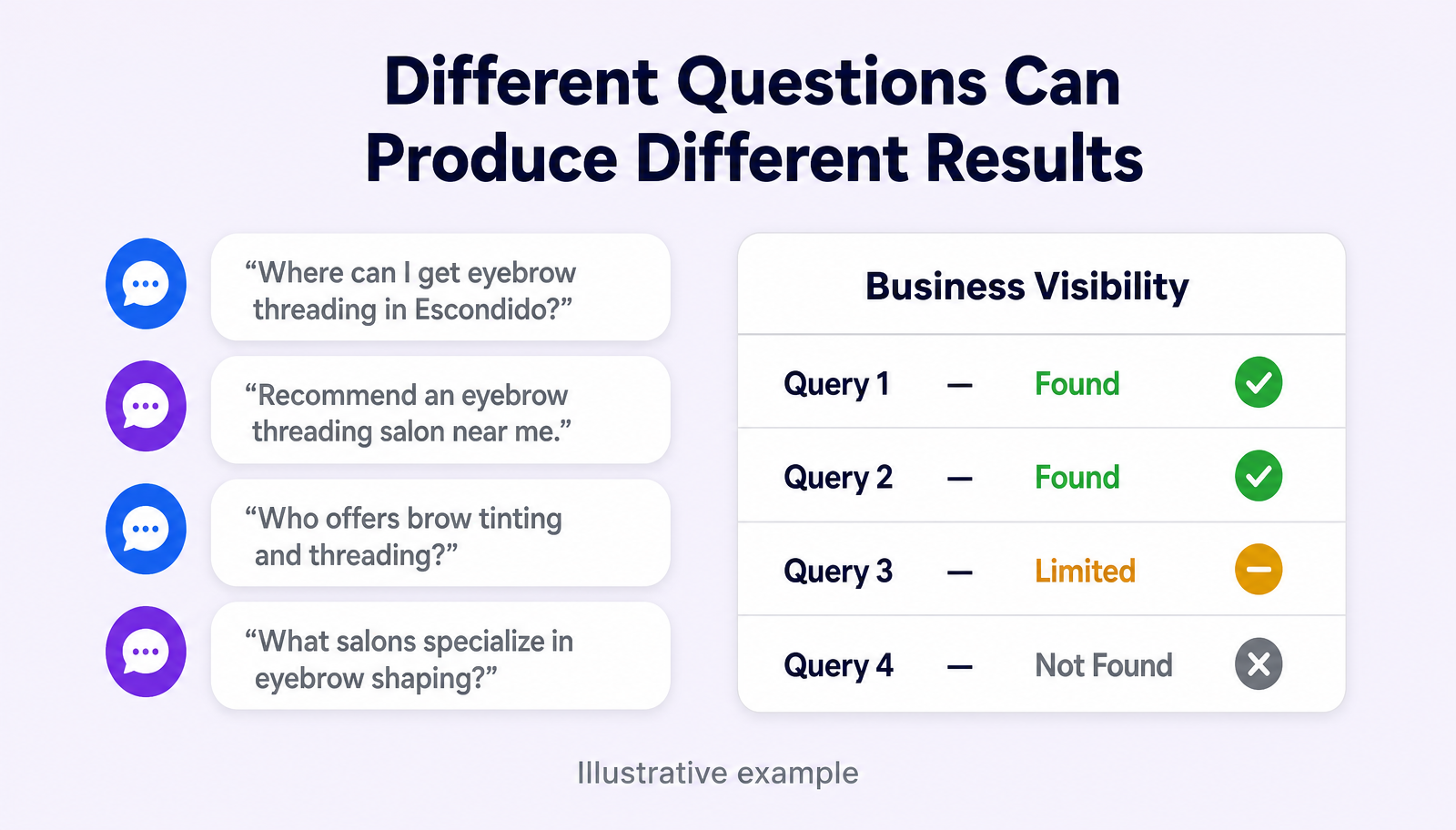
This is extremely important. Your business might appear when someone asks “Where can I get eyebrow threading in Escondido?” but not “Who offers brow lamination near San Marcos?” Those are different intents. AI visibility should therefore not be treated as one permanent yes-or-no measurement. The questions matter.
Can you make ChatGPT recommend your business?
You can improve how clearly your business is represented online. You cannot force ChatGPT to recommend you. There is no legitimate button an outside marketing company can press to guarantee a particular organic recommendation. Businesses should be skeptical of claims such as:
- Guaranteed #1 ChatGPT ranking
- Guaranteed AI recommendations
- Guaranteed ChatGPT placement
The responsible strategy is: measure → understand → improve → monitor.
A better way to test your AI visibility
Don’t perform one ChatGPT search and declare victory. Use realistic customer questions. For example, a beauty business might test:
- Service discovery: “Where can I get eyebrow threading in Escondido?”
- Recommendation: “Recommend an eyebrow threading salon near me.”
- Combined services: “Who offers eyebrow threading and brow tinting?”
- Problem-based discovery: “Where can I get my eyebrows shaped without waxing?”
- Comparison: “What are some eyebrow threading salons around Escondido?”
Then look for patterns. Ask:
- Does my business appear?
- Is my business information accurate?
- Are the correct services understood?
- Which competitors appear?
- Which sources are referenced?
- Do results vary between questions?
- Do results change over time?
That produces much more useful insight than repeatedly asking “Does ChatGPT know my business?”
This is what AI visibility monitoring is really about
The purpose isn’t to chase one mysterious ranking number. The useful business questions are:
- Can AI-assisted discovery understand my business?
- Where does my business appear?
- Where is it missing?
- Which services are correctly understood?
- Which competitors appear when I don’t?
- Is the information accurate?
- What appears to need improvement?
- Did anything change?
Those are practical questions. Local business owners shouldn’t need to become AI engineers to answer them.
Frequently asked questions
Does ChatGPT have a local business directory?
ChatGPT should not be treated as a conventional static business directory. Depending on the question and the product experience, it can search the web and use current information to answer local questions.
Can my website appear in ChatGPT search?
Yes. Public websites can potentially appear in ChatGPT search. Website owners interested in discoverability should ensure appropriate public pages are accessible to OpenAI’s search crawler, OAI-SearchBot. Accessibility does not guarantee placement.
Does location affect ChatGPT search?
It can. ChatGPT search can use approximate location information to make local answers more relevant, and users may optionally enable device-location sharing in supported experiences.
Does ChatGPT use reviews to rank local businesses?
OpenAI does not publish a fixed local-business ranking formula based on review count or star rating. Reviews remain valuable for customer trust and broader online reputation, but no particular number of reviews guarantees ChatGPT placement.
Why did my business appear once but not another time?
Results can vary because of question wording, location, available web information, search results, timing and product behaviour. That is why visibility should be evaluated across multiple relevant customer questions rather than treated as one permanent rank.
Can StayFront.AI guarantee that ChatGPT recommends my business?
No. StayFront.AI never promises control over another company’s AI platform. StayFront helps businesses measure, understand, improve and monitor their AI visibility.
Does ChatGPT understand your business?
See how your business is positioned when customers use AI-powered discovery to find local services.
StayFront.AI measures visibility and provides insights. It does not control or guarantee recommendations from ChatGPT or other independent AI platforms.