
Quick answer
SEO is about how your website performs in a list of search results. AI visibility is about whether an AI assistant mentions your business when a customer asks it a question in conversation. The underlying work overlaps heavily — clear services, accurate business information, a crawlable site — but the outcome is measured differently. A search ranking is a position; an AI mention is an appearance in a generated answer that can vary by question, by platform and over time.
What SEO means
Search engine optimisation is the practice of making a website easier for search engines to find, understand and rank. For a local business, that usually means:
- pages that clearly describe each service you offer
- accurate name, address, phone and hours across the web
- a site that loads quickly and works on a phone
- content that matches what customers actually search for
- links and references from credible third-party sources
Google’s own guidance for local results describes relevance, distance and prominence as factors, and recommends keeping business information complete and accurate. That guidance has not changed because AI assistants exist.
What AI visibility means
AI visibility describes whether AI-assisted discovery experiences surface your business when someone asks a question like “who does emergency plumbing near me on a Sunday?” Instead of ten blue links, the customer gets a short answer naming two or three businesses.
You are either in that answer or you are not — and there is no page two. That is the core reason owners care about it separately. Our introduction to AI visibility covers the concept in more depth.
Where they overlap
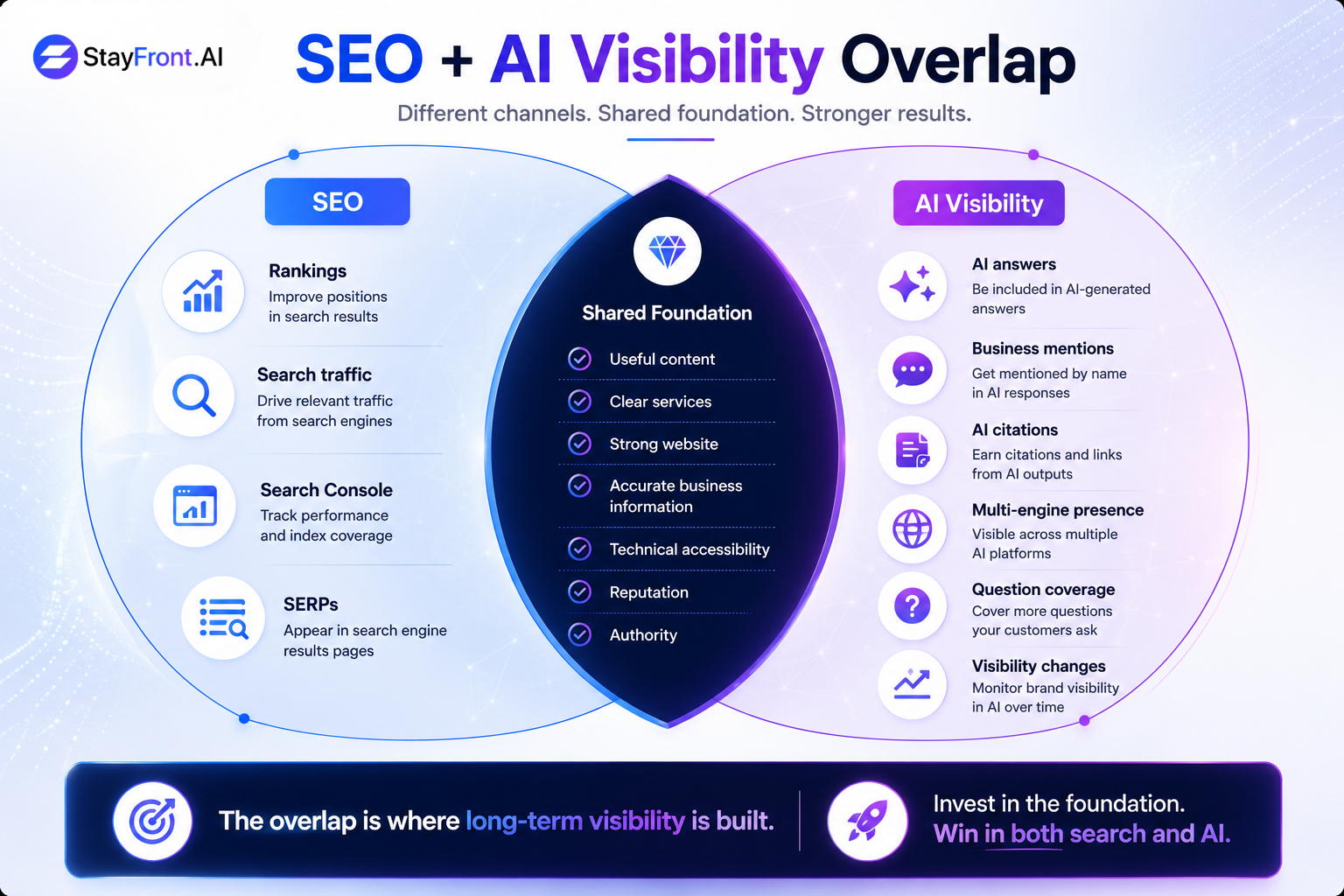
Most of the practical work is shared. An AI assistant that surfaces local businesses still needs information about them, and that information largely comes from the same public web that search engines index.
- A crawlable, accessible website helps both
- Specific service pages help both
- Consistent business information helps both
- Genuine reviews and credible mentions help both
- Accurate structured data helps both
Where they differ
The output shape
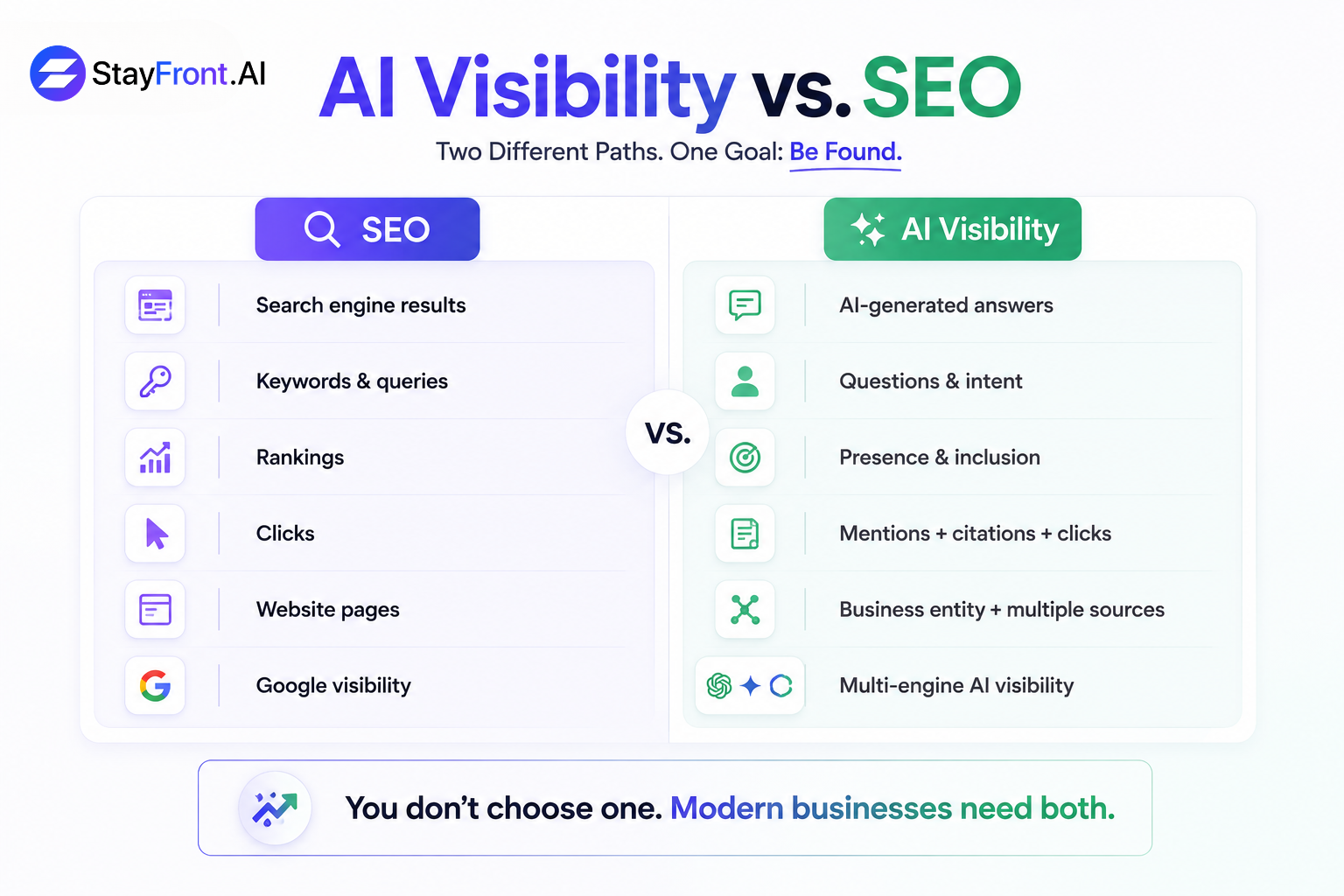
Search returns a ranked list a customer scans. An AI assistant returns a short answer that already made the shortlist for them.
The measurement
SEO is measured with positions and impressions for keywords. AI visibility is measured by whether your business appeared across a set of realistic customer questions, how it was described, and who appeared instead of you.
The stability
A ranking tends to move gradually. An AI answer is generated per question and can differ between two similar phrasings on the same day.
The surface
There is one Google. There are several AI assistants, each with its own sources and behaviour, so “AI visibility” is really visibility across multiple systems.
Where do AEO and GEO fit?
AEO (answer engine optimization) and GEO (generative engine optimization) are industry terms for improving how information is understood and surfaced in answer-style or generative discovery experiences. They can be useful shorthand, but they are not separate switches that replace SEO.
Google's published guidance for its AI search features continues to point site owners back to established search fundamentals rather than a special set of “AI SEO” requirements. That is a good reality check for small businesses: make pages useful, specific, accessible and accurate before chasing new terminology.
- SEO asks whether pages can be discovered and perform in search results
- AEO focuses on making answers and facts clear enough to be retrieved or summarized
- GEO is often used for work aimed at generative or AI-assisted discovery
- AI visibility measures the observable result: whether and how the business actually appears
The labels matter less than the workflow. Build a strong search foundation, make your business information unambiguous, then monitor AI-powered discovery separately so you can see where traditional search performance and AI visibility diverge.
A side-by-side example
Traditional search: “brow lamination Escondido” returns a map pack and a list of ten salons. The customer compares several.
Conversational recommendation: “Where can I get brow lamination in Escondido this weekend?” returns two named salons with a sentence each. The customer usually picks one of the two.
Same intent, very different competitive dynamic. In the second case, being eleventh and being invisible look identical.
Why good SEO can support AI discovery
AI systems that surface current local information generally need to retrieve it from somewhere. If your service pages are thin, your site blocks crawlers, or your listed hours contradict your website, you have made your business harder to summarise confidently — for any system. Good SEO hygiene removes those obstacles as a side effect.
Why ranking in Google does not create a universal AI ranking
There is no shared ranking table that AI assistants read from. Different assistants draw on different sources, retrieve differently and generate their answer per question. Being prominent in Google makes it more likely that clear information about you exists publicly — which helps — but it does not place you into an AI answer.
This is also why testing one prompt proves very little. See how to check your AI visibility properly.
What local businesses should work on first
- Make sure a stranger can tell what you do, where, and for whom within five seconds of landing on your homepage
- Give each significant service its own clearly written page
- Make your location or service area explicit in words, not just on a map embed
- Fix conflicting information between your website, profiles and directories
- Confirm your site is not accidentally blocking crawlers
- Then measure — across several questions, not one
Three business examples
Salon
SEO work: a page for brow lamination that ranks for that term. AI visibility work: making sure “brow lamination” is stated plainly as a service you offer in this city, so an assistant answering “who does brow lamination near me?” has something unambiguous to use.
Plumber
SEO work: ranking for “emergency plumber” in your city. AI visibility work: stating your after-hours availability and covered suburbs in text, because “Sunday” and “near Vista” are the parts of the customer’s question an assistant has to match.
Auto repair shop
SEO work: service pages for brakes, diagnostics and transmissions. AI visibility work: making the makes you specialise in explicit, so “who services European cars near me?” resolves to you rather than to a generic competitor.
How StayFront fits alongside SEO
StayFront does not replace your SEO work. It measures the outcome your SEO tools cannot see: whether AI assistants actually surface your business across a set of realistic customer questions, which competitors appear instead, and whether that changes after you make improvements. Our methodology page explains exactly what we observe and what we deliberately do not claim, and how it works walks through the monitoring loop.
Curious where you stand across AI answers?
See whether AI-assisted discovery surfaces your business — and who shows up instead.
Frequently asked questions
Is SEO dead because of AI search?
No. Much of what AI-assisted discovery relies on — a crawlable website, clear service pages, accurate business information and credible third-party references — is the same groundwork that supports traditional search.
If I rank #1 on Google, will ChatGPT recommend me?
Not necessarily. AI assistants use different sources and retrieval behaviour, and answers are generated per question rather than read from a fixed ranking. A strong Google position helps but does not transfer automatically.
Should a small business do SEO or AI visibility work first?
Start with the shared foundations: accurate business information, clear service pages and a crawlable site. Those improve both. Then monitor AI visibility separately, because it is measured differently.
Can anyone guarantee an AI recommendation?
No. No company controls ChatGPT, Gemini or Perplexity. Any guaranteed AI ranking claim is describing something the platforms do not offer.
Where do AEO and GEO fit?
AEO and GEO are industry terms used for work aimed at answer engines and generative discovery. In practice, much of the useful work overlaps with established SEO: clear content, crawlability, accurate facts, structured information and credible public references. The labels are less important than measuring the actual discovery outcome.