
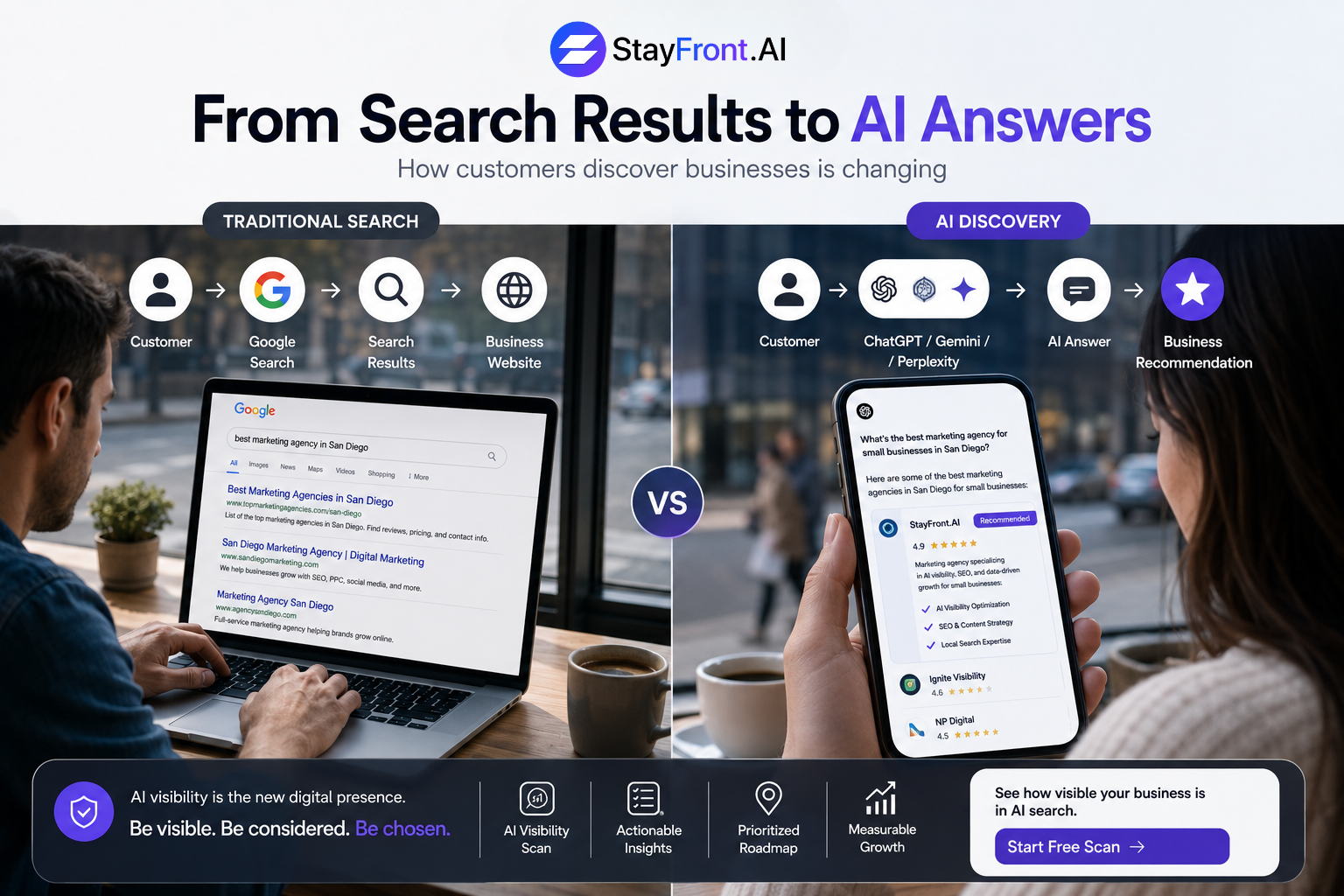
Quick definition: AI visibility describes whether, how often, and how accurately a business appears when people use AI-powered search and assistants to research services, compare providers, or ask for recommendations.
For years, local businesses have worked to answer one important question: “Can customers find me on Google?” Today, there is another question worth asking: “Can AI find and understand my business?”
Consumers can now ask tools such as ChatGPT, Google’s AI experiences, Microsoft Copilot, Perplexity and other AI-powered services questions like:
- “Who does eyebrow threading near me?”
- “Find a reliable plumber in Escondido.”
- “What is a good auto repair shop nearby?”
- “Which local salon offers brow lamination?”
- “Recommend a family dentist near me.”
- “Where can I get my air conditioner repaired today?”
Instead of scrolling through a traditional page of search results, customers may receive a conversational answer containing a smaller set of businesses, sources or recommendations. That is where AI visibility becomes important.
What does AI visibility mean?
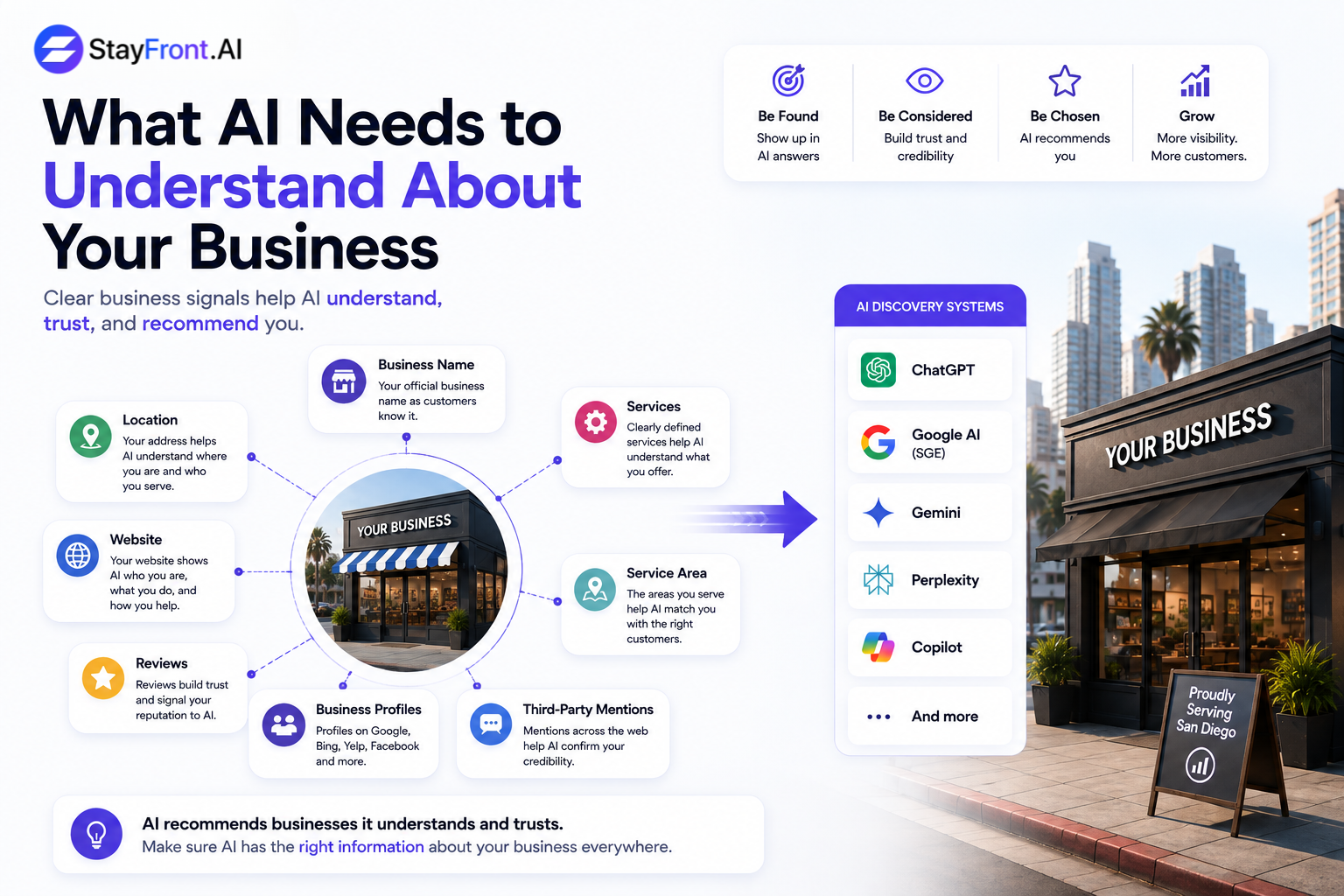
AI visibility is a practical way to describe how easily AI-powered discovery systems can find, understand, reference or surface information about your business when answering relevant questions.
It does not mean that there is one universal “AI ranking” shared by ChatGPT, Google, Perplexity and every other AI system. There isn’t. Different AI services work differently, use different information sources and may produce different answers.
Think of AI visibility as answering questions such as:
- Does an AI system know that your business exists?
- Does it understand what services you provide?
- Does it understand where you are located?
- Can it find accurate information about your hours, services and website?
- Does it associate your business with the services customers actually ask about?
- Can it find supporting information about your business from other places on the web?
- Does your business appear when relevant local recommendations are requested?
- Is the information being surfaced about your business accurate?
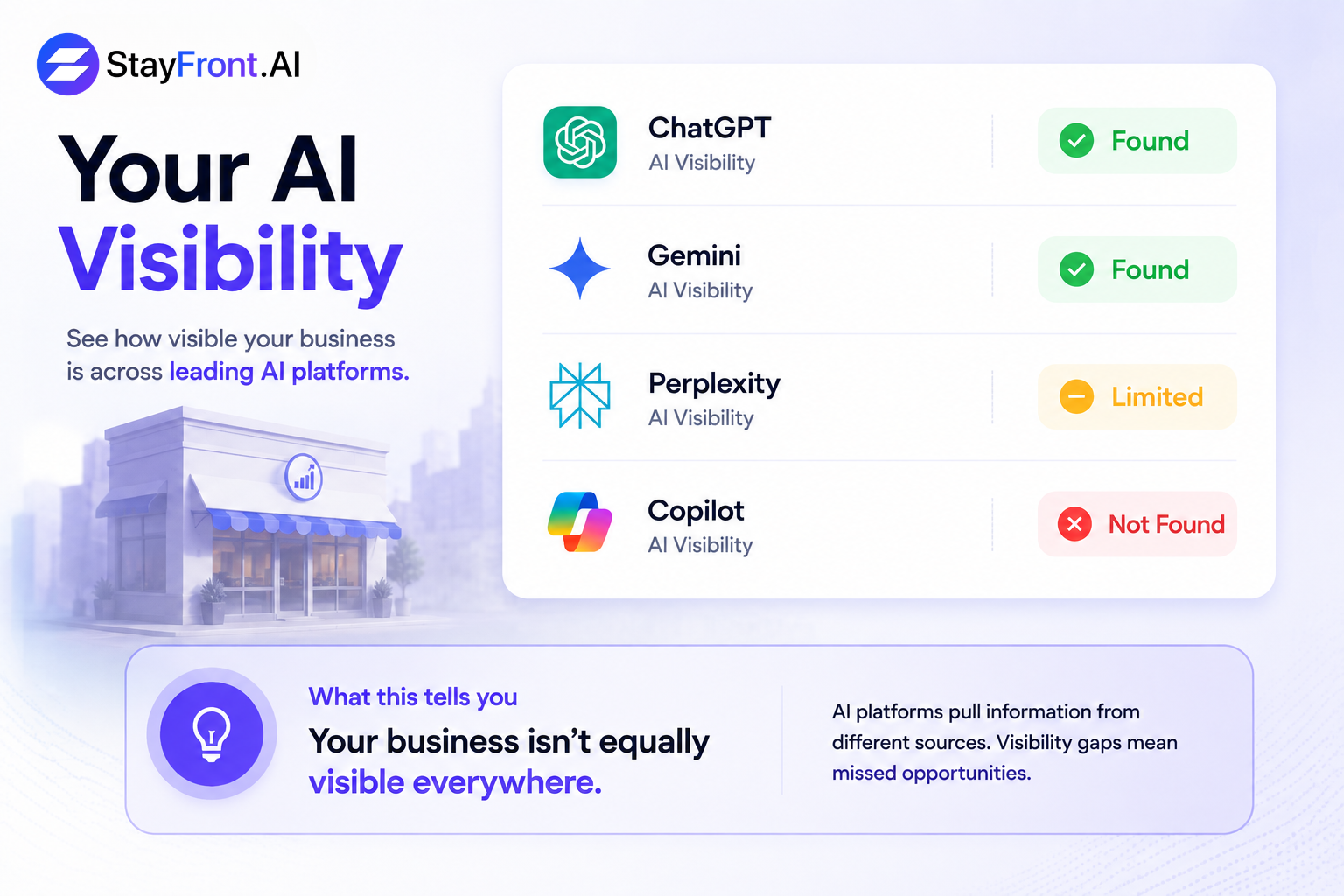
A business can therefore have strong visibility in one AI experience and weak visibility in another. That is one reason monitoring multiple AI discovery experiences is becoming useful.
What does AI visibility mean for a local business?
For a local business, AI visibility is not just whether the company name appears somewhere in an answer. It is whether the business is surfaced for the kinds of questions a real customer would ask about a service, location, availability, reputation, or specialty.
A useful local-business check therefore looks across several customer intents rather than one vanity prompt. A salon might be visible for “eyebrow threading near me” but absent for “brow lamination in Escondido.” A plumber might appear for general plumbing but not for an emergency water-heater question. Those gaps are more actionable than a single yes-or-no result.
What does AI visibility mean for a brand?
For a brand, the concept is broader: can AI-powered discovery systems identify the brand, describe it accurately, connect it with the right products or services, and surface credible information about it when users compare options? Large brands may track many product, reputation, and competitor questions. A small business can use the same principle on a much smaller, practical set of customer questions.
What is an AI visibility platform?
An AI visibility platform helps automate the repetitive work of checking customer-style questions, organizing whether a business appeared, comparing competitors, and tracking the pattern over time. It should not be confused with a tool that claims to control or guarantee placement inside an independent AI product.
How is AI visibility measured?
There is no universal industry score shared by every platform. A useful measurement approach starts with a stable set of realistic questions and records observable outcomes such as:
- whether the business is mentioned
- which services or locations trigger a mention
- which competitors appear instead
- whether the description is accurate
- how coverage changes across supported discovery experiences
- whether the pattern changes when the same questions are repeated later
That is why StayFront.AI treats AI visibility as a monitoring problem rather than a one-time certification or a permanent ranking.
A simple example
Imagine that you own a beauty salon in Escondido, California. Your website says:
Beauty Salon in Escondido
But customers rarely search using only that phrase. They may instead ask:
- “Where can I get eyebrow threading near Escondido?”
- “Who offers brow lamination near me?”
- “Find a place for Brazilian waxing in Escondido.”
- “Which salon nearby has good reviews for eyebrow threading?”
If your website, business profiles and other public information clearly describe those services, your business is easier for search and AI systems to understand. But imagine another salon has:
- a detailed website page about eyebrow threading
- accurate location information
- consistent business details
- customer reviews discussing eyebrow threading
- mentions on reputable local websites
- clear service descriptions
- information that is accessible to search crawlers
An AI-powered search experience may have considerably more context available when trying to understand that competitor. This doesn’t guarantee that the competitor will be recommended. But it illustrates an important principle: AI systems can only work with the information they can access and understand.
Why is AI visibility becoming important?
Traditional search is not disappearing. People will continue using Google Search, Maps, directories, review sites and business websites. What is changing is how people ask questions.
Traditional search might look like:
plumber escondido
An AI-style query might be:
“I have a leaking water heater. Can you recommend a well-reviewed plumber near Escondido who handles water heaters?”
That is a much richer question. Instead of looking only for a matching phrase, an AI experience may need to understand:
- the service needed
- the customer’s location
- the type of problem
- relevant businesses
- available information about those businesses
- and potentially current information from the web
ChatGPT, for example, can search the web for current information, provide links to relevant sources and use location information for certain local searches. OpenAI also states that public websites can potentially appear in ChatGPT search and provides a search crawler called OAI-SearchBot for discovering web content. For business owners, this creates a new discovery surface alongside traditional search.
Is AI visibility the same as SEO?
No, although they overlap significantly. SEO — search engine optimization — helps search engines crawl, understand and surface your website in traditional search experiences. AI visibility focuses more broadly on whether AI-powered discovery experiences can understand and surface your business when answering relevant questions.
Strong SEO can help create a strong foundation for AI discovery. For example, both benefit from:
- clear website content
- accessible pages
- useful service information
- good site structure
- accurate business information
- authoritative references
- content written for real customers
Google itself states that its established SEO best practices remain relevant to its AI features and that there are no special additional requirements simply for appearing in Google AI experiences. But AI visibility deserves additional attention because conversational discovery can involve more than whether one webpage ranks for one keyword.
What can affect your business’s AI visibility?
There is no published universal formula that determines which local businesses every AI platform will recommend. Be cautious of anyone promising:
“We can guarantee that ChatGPT will rank your business #1.”
No legitimate service can guarantee that. OpenAI itself states that there is no way to guarantee top placement in ChatGPT search. Instead, businesses should concentrate on improving the information that discovery systems have available.
1. Clear website content
Your website should make it easy to understand:
- who you are
- what you do
- where you operate
- which services you offer
- how customers can contact you
A homepage saying:
“Welcome to Smith & Co. We provide exceptional solutions.”
doesn’t explain much. A clearer description might be:
“Smith Plumbing provides residential plumbing, water heater repair, drain cleaning and emergency plumbing services throughout Escondido and North San Diego County.”
The second version provides substantially more context.
2. Accurate business information
Make sure important business details are correct wherever customers encounter them. That may include:
- business name
- address
- phone number
- website
- service area
- hours
- business category
- services
Google recommends maintaining complete and accurate business information and explains that its local results consider factors including relevance, distance and prominence. Consistency also reduces confusion for customers.
3. Specific service information
Don’t make AI systems — or customers — guess what you offer. A salon should not rely only on “Beauty Services.” Individual services might include:
- eyebrow threading
- brow tinting
- brow lamination
- facial waxing
- Brazilian waxing
- lash services
A contractor might separately explain:
- kitchen remodeling
- bathroom remodeling
- flooring
- roofing
- room additions
Specificity helps establish what your business is relevant for.
4. Your reputation across the web
Your own website is not the only place where information about your business may exist. Customers may discuss or find your business through:
- review platforms
- local directories
- professional associations
- news coverage
- community websites
- social profiles
- industry directories
- other third-party sources
These sources create additional context around your business. The goal should not be to manufacture hundreds of low-quality listings. The goal should be to create an accurate, credible and useful public presence.
5. Whether your website can be accessed
Excellent content provides limited discovery value if automated search systems cannot access it. Technical issues can include:
- accidental noindex settings
- crawler restrictions
- pages hidden behind authentication
- broken internal links
- incorrect canonical URLs
- server errors
- security systems blocking legitimate crawlers
For ChatGPT search specifically, OpenAI advises publishers that want their content discoverable to allow OAI-SearchBot rather than blocking it.
6. Location context
Local business discovery is naturally location-sensitive. The answer to “What’s the best pizza place near me?” should be different for a customer in San Diego than for one in Chicago. ChatGPT can use location information in certain search experiences to provide more relevant local results. That makes clearly communicating your physical location or service area especially important for local businesses.
What does good AI visibility look like?
There is no single definition. A healthy AI visibility picture could mean that:
- your business can be found across several relevant AI experiences
- your primary services are understood correctly
- your location is understood
- information surfaced about your company is accurate
- relevant sources support your business information
- visibility remains reasonably consistent over time
It is also useful to know where gaps exist. For example:
ChatGPT
Business discovered for several relevant questions.
Another AI engine
Business discovered, but services are incomplete.
Another discovery experience
Competitors appear more consistently.
That difference gives the owner something actionable to investigate.
How can you improve AI visibility?
Start with the fundamentals.
- Make your business unmistakably clear — your website should answer who you are, what you do and where you do it.
- Create useful service pages, giving important services enough information to stand on their own.
- Keep your business information accurate by auditing major business profiles and public sources.
- Strengthen your reputation: encourage genuine customer feedback and earn legitimate mentions.
- Make your website technically accessible so important public pages can be discovered and indexed where appropriate.
- Monitor rather than guess — AI discovery experiences change.
A one-time check tells you what happened today. Ongoing monitoring helps you understand whether visibility is improving, declining or changing.
Can you pay to guarantee AI recommendations?
Organic recommendations and sponsored placements are different things. A business should be skeptical of any company promising guaranteed organic recommendations from ChatGPT or another AI platform. AI systems determine answers using their own technologies and available information. There is no button a marketing agency can press to force every AI assistant to recommend a particular local business.
The better approach is: measure → understand → improve → monitor.
How StayFront.AI approaches AI visibility
StayFront.AI is designed to help local business owners understand AI visibility without requiring them to become AI or SEO experts. The goal is simple:
- See how your business is being discovered.
- Understand where visibility may be weak.
- Identify practical actions.
- Monitor what changes over time.
Instead of asking a business owner to manually test multiple AI systems every week, StayFront brings visibility information into a simpler monitoring experience. No promise of guaranteed rankings. No claim that one score controls ChatGPT. Just a clearer way to understand an increasingly important part of online discovery.
Frequently asked questions
What is AI visibility?
AI visibility describes how easily AI-powered discovery systems can find, understand, reference or surface information about a business when responding to relevant questions.
Can I guarantee my business appears in ChatGPT?
No. There is no legitimate way to guarantee that ChatGPT or another independent AI system will recommend a particular business for every relevant query.
Is AI visibility replacing SEO?
No. Traditional SEO remains important. AI visibility adds another layer to online discovery as consumers increasingly use conversational and AI-assisted search experiences.
Do small local businesses need to care about AI search?
Increasingly, yes. Local businesses depend on discovery. If consumers use AI tools to decide where to eat, shop, book an appointment or hire a service provider, understanding your presence in those experiences can become valuable.
How often should I check AI visibility?
There is no universal schedule, but visibility should be treated as something that can change rather than a one-time certification. Periodic monitoring makes it easier to identify meaningful changes.
Can AI find your business?
You don’t need to understand algorithms to start asking the right question. Enter your business name, city and website, and begin checking how your business is positioned for AI-powered discovery.
StayFront.AI helps businesses measure and understand AI visibility. No platform can guarantee placement or recommendations within independent AI services.