
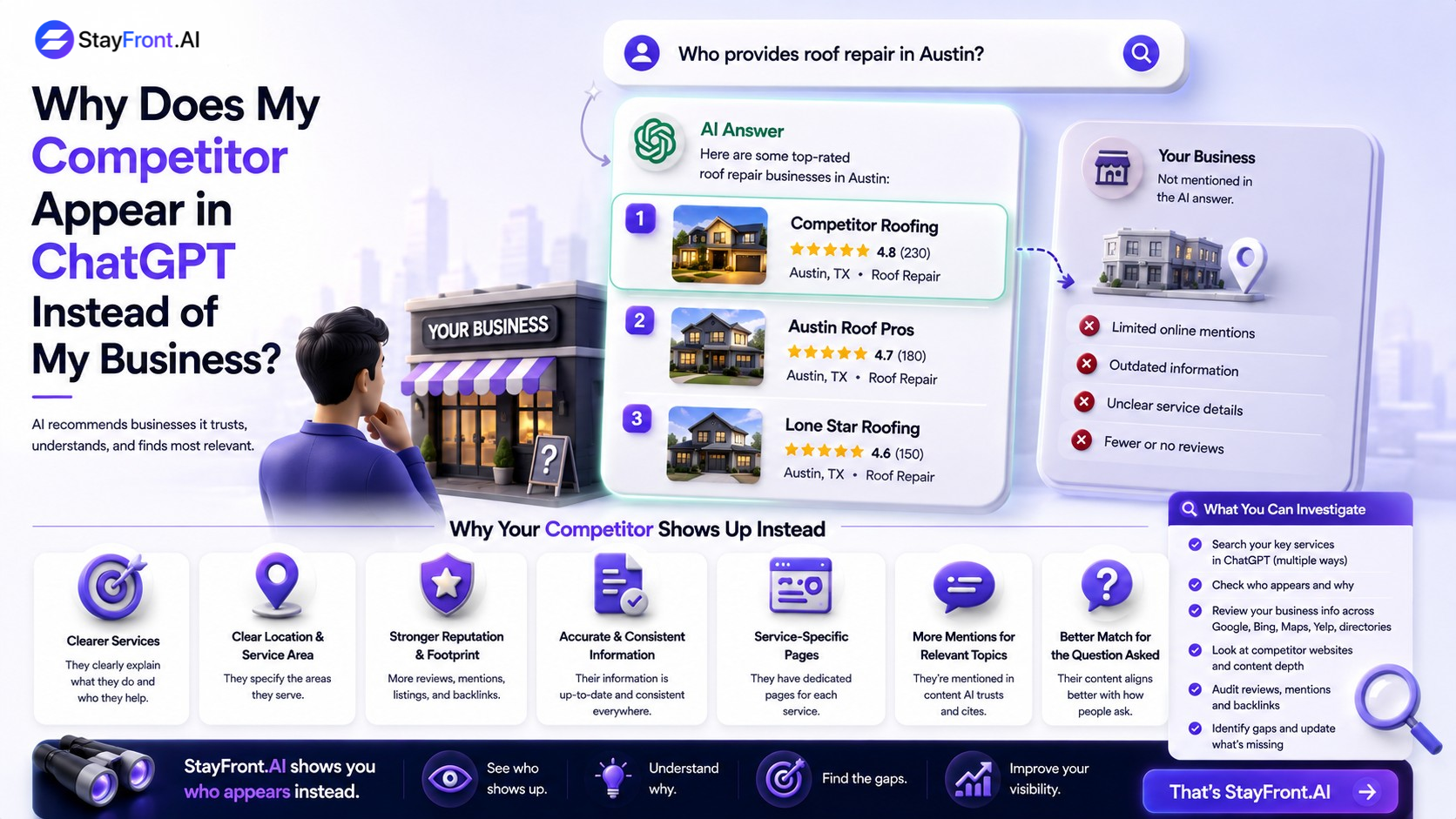
The scenario every home service business runs into
Someone searches "who provides roof repair in Austin" in an AI assistant. The answer names three roofing companies — reviews, ratings, service area, all laid out clearly. Your business isn't one of them, even though you do the same work in the same city. This isn't random. AI assistants recommend businesses they can understand clearly and verify confidently — and there are specific, fixable reasons a competitor clears that bar and you don't.
The 7 reasons a competitor gets recommended instead of you
Clearer services
Businesses that clearly explain exactly what they do, and who they help, give an AI assistant something specific to match against a specific question. "Roof repair, roof replacement, storm damage inspection" beats "roofing services" every time.
Clear location and service area
Naming the specific areas you serve — not just your home city — is what lets an AI assistant confidently include you for a searcher one town over.
Stronger reputation and footprint
More reviews, more mentions across the web, and more listings and backlinks all add up to a business an AI assistant can verify from multiple directions, not just one.
Accurate and consistent information
If your hours, services, and contact details are outdated or inconsistent across your website, Google Business Profile, and directories, that inconsistency makes it harder for an AI assistant to trust any single source.
Service-specific pages
A dedicated page for "roof repair" and a separate one for "roof replacement" give an AI assistant a direct, specific page to point to — a single generic services page doesn't.
More mentions for relevant topics
Businesses that show up in more places talking about the specific topic someone searched — not just their own homepage — tend to be the ones AI assistants cite and trust more readily.
Better match for the question asked
The business whose content most directly answers the specific question — not just related in general — is the one that gets pulled into the answer. "Emergency roof repair after storm damage" matches a specific question far better than a general "contact us for roofing needs."
What you can investigate today
- Search your key services in an AI assistant, phrased a few different ways ("roof repair near me," "who fixes storm damage roofs in [city]")
- Check who appears in the answer, and look at what they have in common
- Review your business information across Google, Bing, Maps, Yelp, and relevant directories for consistency
- Look at your competitors' websites and how much content depth they have on individual services
- Audit your own reviews, mentions, and backlinks
- Identify the specific gaps between what your competitor has and what you're missing, then update accordingly
Frequently asked questions
Why does a competitor with fewer years in business sometimes outrank me in AI search?
AI assistants weigh clarity and verifiability more than tenure alone — a newer business with clear, specific service pages, consistent information, and active reviews can be easier for an AI assistant to confidently recommend than an established business with outdated or inconsistent listings.
Is this the same as regular SEO ranking?
It's related but not identical. Traditional SEO focuses on ranking in search engine results pages. This is about whether an AI assistant includes and names your business directly in a generated answer, which depends more on clarity, consistency, and specific service matching than on traditional ranking signals alone.
How often should I check how I compare to competitors in AI search?
There's no fixed schedule, but checking periodically — especially after updating your services, service area, or business information — helps you catch gaps before a competitor's advantage becomes entrenched.
Continue with StayFront.AI